09.12.2014

Voices of reason in Germany


Following is the text of a speech on November 26 by Dr. Sarah Wagenknecht, member of the German Bundestag and deputy leader of the “Linke” party, where she criticizes German Chancellor Angela Merkel for serving US demands instead of protecting her own countries interests:
sahra-wagenknecht-interview
One gets the impression that there is something, Mrs. Merkel, that you think is even more important than the interests of German business: it is the interest of the US government and American business.

In your speech in Sydney, Mrs. Merkel, you are terribly outraged by the fact, that 25 years after the fall of the Berlin Wall there continues to exist an old way of thinking of “spheres of influence” which tramples on international law. “Who would have thought!” — you were quoted. That begs the question, Mrs. Merkel, where on earth do you live? And where have you been living the past 25 years?

Where were you when the United States trampled international law in Iraq, to expand its sphere of influence over Iraqi oil? Where were you, when with German participation international law in Afghanistan was and still is being trampled upon? Where were you when Libya was bombed, when the Syrian opposition was armed and affiliated with ISIL after weapons deliveries?

Was all that, in your opinion, in accordance with international law? Of course, it was not at all about spheres of influence!

I can recommend you to read Zbigniew Brzezinski’s book, who has long been a pioneer of American foreign policy. The beautiful title of this book, written in 1997, reads as follows: “The Grand Chessboard: American Primacy and Its Geostrategic Imperatives.”

With regard to Europe, Brzezinski argues for a decisive NATO expansion eastward, first in Central Europe, then in the South, then in the Baltic States, and finally in the Ukraine. Because, as the author convincingly justifies, quote: “every step of expansion automatically expands the immediate sphere of influence of the United States.”

This is an old way of thinking in terms of “spheres of influence,” which was very successfully implemented, and you really never, ever noticed it, Mrs. Merkel? On the contrary, you belonged to those who further implemented and supported that in Europe! You were just one of the “vassals,” to use Brzezinski’s words, which endorsed this strategy.

[Interuption by the house speaker]

I was talking about Brzezinski, NATO enlargement to the east and German policy in this regard. Mrs. Merkel, now you’ve driven Germany to a renewed “Cold War” with Russia, poisoned the political climate and jeopardized the peace in Europe. You have instigated a senseless economic war, which massively harms primarily the German and European economy.

To the auditorium: Do not moan so, you’re not the one working for companies whose orders have dropped sharply, you’re not the ones running or working for these enterprises. You don’t have to deal with the hard consequences of what you have done.

You are warning us of fire, Mrs. Merkel, but you are among those who are running around with lighted matches. Verbal escalation is always what becomes before things worsen! That is what Hans-Dietrich Genscher told you after your speech in Sydney. No, it doesn’t mean we love Putin, or Russian capitalism with its oligarchs, but diplomacy means taking the interests of the other side seriously, rather then ignorantly pushing them away.

And it cannot be ignored when Mikhail Gorbachev and Helmut Kohl almost with the exact same words warn, that without the German-Russian partnership no stability and security in Europe is possible.

The former chairman of the SPD Matthias Platzeck pointed out, that trade between Russia and the US this year has grown, while trade between Russia and the EU, primarily Germany, has experienced a huge collapse. As a reaction, the CDU tries to squeeze people like Mr. Platzeck, and other supposed “Putin apologists” out of the “Petersburg Dialoque” conference.

Instead of backing understanding, you are encouraging ignorance! In Ukraine, you cooperate with a regime, in which important functions of the police and security services are occupied by recognized Nazis! President Poroshenki talks of “total war!” He stopped all payments to pensioners and hospitals in eastern Ukraine! And for prime minister Yatsenyuk the insurgents are, quote: “creatures, which must be destroyed!”

Instead of working with these thugs, we finally again need a German foreign policy, in which security and peace in Europe is more important than the instructions from Washington. In a year which marks the centenary of the outbreak of World War I and 75 years after that of World War II, in such a year it would, I think, be extremely appropriate to remember a saying of Willy Brandt: “War — this is not the ultimate ratio [Latin for: the most reasonable argument], war is the ultimate irratio [the most foolish argument].

War cannot be used as a political tool any longer, Mrs. Merkel! So go back to the path of diplomacy, the lifting of sanctions! And if indeed within the SPD there are voices calling for common sense in foreign policy, from Helmut Schmidt to Matthias Platzek, then please listen, Mrs. Merkel, to the voices of your coalition partners! Stop playing with fire!

I summarize: You have squandered all the gains of “detente” politics and led Europe into a new Cold War, and to the brink of a flash fire, because you do not have the courage to stand up to the US government. This is not something that you can be proud of. The citizens of our country in any case deserve better politics, politics where the call for prosperity for all is finally taken seriously, and return to a friendly neighborhood policy with all of our European neighbors.

The YouTube video of this speech:
https://www.youtube.com/watch?v=gnHPmcUgfRU
Other speeches:

What is your legacy, dear traveller?


In memory of Babycat, a beautiful and very intelligent one year old cat, killed by an idiot who drove by my house in his fancy coupe at much too high speed.

It is December but temperatures are still moderate. This will again be the warmest year in documented history. Many animals which normally at this time would started hibernating or would have retreated to their hideouts in the forest are still active. In fall the animals are preparing for winter and they are desperately searching for food, which means that many have to pass roads and many are killed by carless drivers.

By careless drivers or by sadistic drivers.

A study in Ontario, Canada in 1996 found many reptiles killed on portions of the road where vehicle tires don’t usually pass over, which led to the inference that some drivers intentionally run over reptiles. To verify this hypothesis, research in 2007 found that 2.7 percent of drivers intentionally hit reptile decoys masquerading as snakes and turtles. Several drivers were observed even speeding up and positioning their vehicles to hit the reptiles. Male drivers hit the reptile decoys more often than female drivers.

A few weeks ago I saw four dead hedgehogs on the road, a big one and three smaller ones. This was clearly a mother and her three children. I assume that the mother crossed the road and was killed and her children followed her and gathered around her body confused and disturbed just to be killed by the next car. It was a part of the road where one has to drive slowly and where one can easily see any approaching animals.
I was furious, incensed, and deeply saddened.

Well, I have killed animals too. I drive as careful as possible and I never have killed a cat or a hedgehog but once a pheasant flew across my way unexpectedly from bushes beside the road and was killed by the car. Two times little birds crashed against my windscreen. Luckily I don’t have to commute or use the car commercially, I use it only if there is no other way to fulfill a task. I drove only 6,000 kilometers in the two years since I bought the car.
roadkill 12 2014 9
In the last days I have again seen various dead animals on the road and that prompted me to look up an old text  in order to publish it in an updated version on the blog. When I read the text I first felt, that it was too harsh and bitter, but when I collected some pictures about roadkill I was again deeply saddened, I was shocked and completely knocked off my feet — the text suddenly seemed to be appropriate.

Therefore, here is the text, updated but unredacted and unsanitized.

What is your legacy, dear traveller?

Driving on the road for a longer time can be quite boring. All kind of things will come into your mind, scenes from your workplace, memories of your childhood, thoughts about your private life. You will be reflecting, musing, speculating, contemplating, considering, Every thought will lead you to another thought and the pictures in your mind will constantly change like in a slideshow. You cannot do much against the steady flow of association, the “brain chatter” — except if you have some experience in meditatiing.

Maybe you will also occasionally think about the meaning of it all, the quintessential meaning of your life. You will think about your goals and your expectations. You will think about your legacy.

When you are driving on the road, dear traveller, you only have to look to the roadside, to find out about your legacy. As you are driving along, the landscape will pass by like a film and you can easily imagine to sit in a comfortable chair in a movie theater instead of sitting in the driver seat of your car. You will see buildings, fences, some bushes, billboards, and signs. You will pass crossings, bridges, overpasses, and tunnels.

But the objects mentioned before are not what will define your legacy, Your legacy will be defined by things which are much more prevalent, things that aren’t supposed to be part of the landscape along the road, but nevertheless are and always will be.

When you are driving on the road, dear traveller, you will quite often see garbage, that other drivers have thrown away. You will see aluminum cans, plastic bottles, juice cartons, empty cigarette packs, cups, wrappers and bags, tissue paper and cardboard boxes, and various other discarted items. 

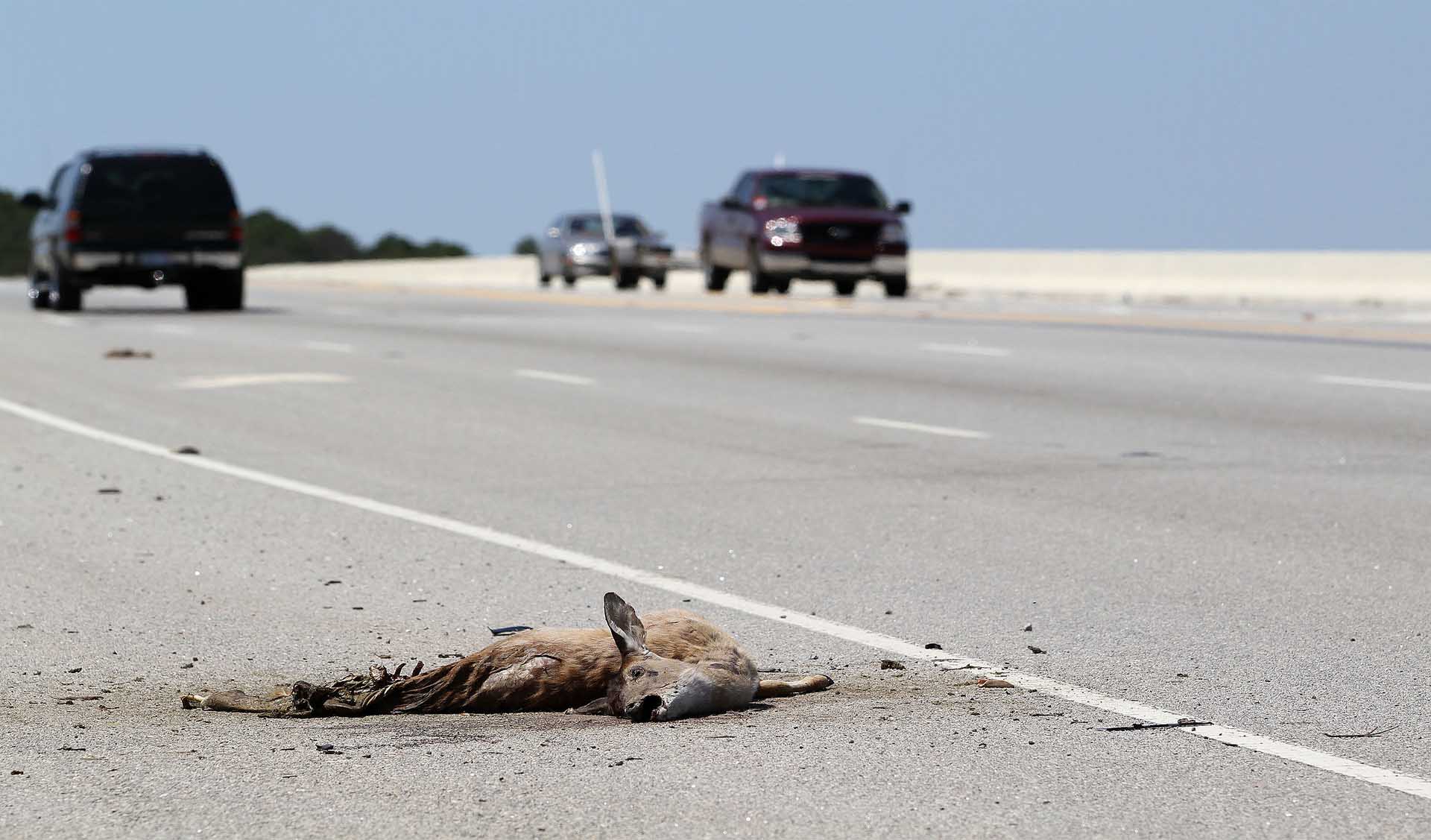
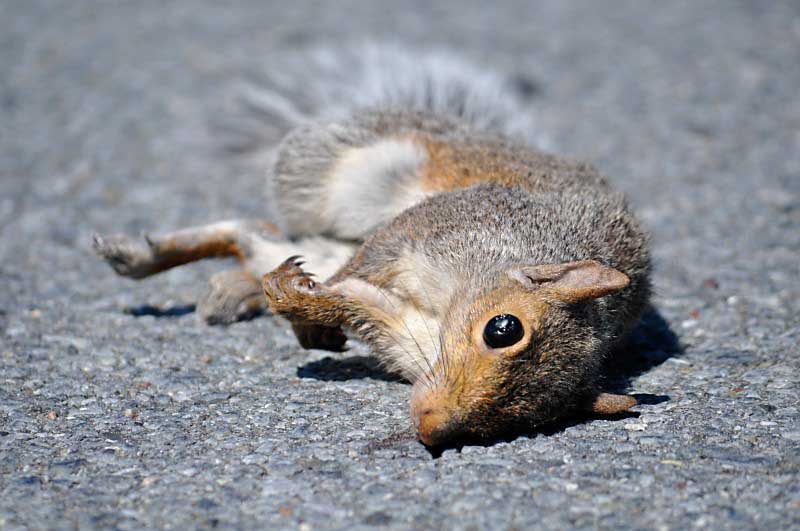
And you will often see dead animals. You will see dead cats, dogs, hedgehogs, rabbits, deer, squirrels, birds. Occasionally you will see squashed lizards, frogs, and toads, but as these species are declining rapidly, dead lizards, frogs, and toads are now a rather rare occurrence.
roadkill 12 2014 16
Normally you will not pay attention to the waste and the animal cadavers that are laying on the roadside. The pictures of litter and dead animals are annoying and disgusting, so you will try to overlook them, filter them out in your mind and not think too much about it. This is not your problem!

You never killed an animal with your car? What about the butterflies and beetles and bees, that you have to scrape off the windscreen? Didn’t you occasionally find some feathers on your car grill? Are you sure, that you never squashed a frog or a hedgehog without even noticing it?

So what? Lets get over it and have fun riding the highways and byways.

Q: Why did the hedgehog cross the road?
A: To see his flatmate.

There’s nothing wrong to laugh about an innocent joke.
roadkill 12 2014 12
Canadian writer Timothy Findley wrote about the experience of seeing killed animals on highways during travels: “The dead by the road, or on it, testify to the presence of man. Their little gestures of pain — paws, wings and tails — are the saddest, the loneliest, most forlorn postures of the dead I can imagine. When we have stopped killing animals as though they were so much refuse, we will stop killing one another. But the highways show our indifference to death, so long as it is someone else’s. It is an attitude of the human mind I do not grasp.”

According to a report from the US Transportation Department, 1 million to 2 million wild deer, mountain lions, bears, foxes, squirrels, and other wildlife are killed every year by vehicles on the highways,. The department also estimates that 21 protected species (like the desert tortoise) are jeopardized by vehicle collisions.

Worldwide over one billion wild and domesticated animals die on the roads every year. That are only the mammals, it is not possible to estimate the number of birds, amphibians, reptiles, and insects that are killed by cars.

Wildlife experts in Europe suspect, that road traffic is a significant factor in the decline of species like frogs, toads,  hedgehogs, and European badgers.

Roadkill is considered to significantly contribute to the population decline of many threatened species, including wolves, koalas, and eastern quolls. In Australia the most common species affected by roadkill are brushtail possums and Tasmanian pademelons.
roadkill 12 2014 6
Roads have also a serious indirect impact on wildlife. Many species develop road aversion, they are disturbed by cars and waste valuable energy in flight. Animals are displaced by roads and cut off from their favorite mating areas. The roads cut the animal habitat into little pieces and cause fragmentation and isolation of species. Many animals are prevented from migrating. The mating calls of birds and frogs are drowned out by car noise — many make their calls in vain.

Dear traveller, you don’t have to kill the animals directly with your car to make the biggest mass extinction since the disappearance of the dinosaurs a part of your legacy. You don’t have to run them over, it is evenly effective, when you buy stuff that is produced in factories, because the production will use resources and will pollute the biosphere. The mining of resources will cause terrible harm to the environment (mountain top removal, deep water oil drilling, hydraulic fracturing). Most production processes generate poisonous waste, that is either stored in reservoirs (like the toxic sludge from aluminum plants) and landfills, or released into rivers. All industrial production processes need big amounts of energy that is generated partly in caloric power plants.

You don’t have to kill the animals with your car, there are many other methods to contribute to the demise of our fellow animals. You can for instance eat industrial produced food, because industrial agriculture uses fast amounts of fossil fuels and pollutes the environment with pesticides and fertilizers (nitrogen, phosphorus, potassium). Fertilizer run-off and waste from animal factories causes eutrophication in lakes and coastal zones of oceans. Methane emissions from crop fields and animal factories contribute to climate change.

According to a widely discussed comprehensive study by the Zoological Society of London, the number of wild animals on Earth has halved in the past 40 years. Every time a new study is published, the decline is found to be more dramatic. If present trends continue half of all species will be extinct by the end of this century as a result of hunting and fishing, habitat destruction, pollution, invasive species, and climate change.
roadkill 12 2014 11
Dear traveller, this is one part of your legacy, the other part is the garbage, that results from our modern lifestyle. Of course, you are a tidy person, who never threw anything out of the window of your car. You put all of your waste into the thrash cans, you also separate the waste and put the metals and the plastic and the paper into recycling bins.

And from there it goes into landfills and incinerators.

The highly contaminated leachate and methane from landfills, the sewage sludge from wastewater treatment plants, the filter ash from incinerators goes also somewhere…

Global solid waste generation is expected to double from one billion tons in 2010 to two billion tons by 2025 and 4 billion tons  by 2100.

The North Pacific Subtropical Gyre is a swirling mass of refuse and collects trash from all over the world. It is the planets biggest landfill. Plastic in the oceans has devastated albatross populations and kills many other marine animals, especially the ones which are filter feeders. 80 percent of ocean trash originates on land, the rest comes from ships, fishing equipment, oil platforms, and spilled shipping containers.

1.2 billion cellphones or smartphones, 260 million computers, and an equivalent amount of tablets are sold every year. The lifespan of computers and cellphones in the rich nations has dropped below two years, but only 14 percent of electronic waste is recycled.

Whatever you do, you will produce waste. Did you eat something today that you bought instead of plugging it from a tree or pulling it out from the earth? Did you flash the toilet today? Did you use a facial tissue? Is this your first car?
roadkill 12 2014 14
Dear traveller, as you drive along, you will always see garbage and killed animals along the way and you will be constantly reminded about your legacy. It is not a honorable legacy, but you don’t have to worry about being held in disregard and shamed by your descendants, this legacy will not last, it will be erased completely.

The mass extinction of species will upset the ecological balance and diminish food resources. Algal blooms will reduce fish in oceans and lakes, the disappearance of pollinators will reduce the availability of fruits, nuts, and vegetables. Deposits of fossil fuels, minerals, and metals will eventually get depleted and drinkable unpolluted water will become even more rare. The nations will wage terrible wars over dwindling resources and over water sources.

When finally the nuclear bombs will fall nearly everything will be whipped out. It will take several hundred thousand years, maybe a million years, to heal the scars of the planet, but eventually plants and some animals will adapt to the high level of radiation, the changed climate and the pollution of the ecosphere by heavy metals, dioxins, and other human induced poisons. And as radiation diminishes and chemical compounds dissolve a new ecosystem will emerge and another species will built a new civilization. And the scientist of this new civilization will study the history of the planet and try to find out the reason for the big catastrophe that nearly whipped out all life and they will hopefully come to the right conclusions and advice their peers to make it better.

And your legacy, dear traveller?

There will be no legacy — drive on carefree, lighthearted, untroubled, and enjoy your ride.
roadkill 12 2014 8

08.12.2014

Links December 2014


Environmental news:
http://truth-out.org/opinion/item/27636-united-nations-calls-for-an-end-to-industrialized-farming
http://news.nationalgeographic.com/news/2014/12/141205-world-soil-day-soil-agriculture-environment-ngfood/
http://nypost.com/2014/11/16/toxic-veggies-found-in-nycs-community-gardens/
http://www.independent.co.uk/news/science/triclosan-soap-ingredient-can-trigger-liver-cancer-in-mice-warn-scientists-9866176.html
http://www.theepochtimes.com/n3/1098962-more-toxins-in-clothes-than-previously-believed/
http://www.theguardian.com/environment/2014/nov/28/fracking-risk-compared-to-thalidomide-and-asbestos-in-walport-report
http://www.scmp.com/news/china/article/1653877/heavy-metal-pollution-hunan-soil-exceeds-chinas-limits-1500-times
http://www.livemint.com/Politics/765bka9vVaQAiFxKRGtqRL/The-endless-wait-for-a-cleanup-in-Bhopal.html
http://www.bloomberg.com/news/2014-12-05/amid-india-s-coal-fields-death-lurks-in-poisoned-water.html Why does Bloomberg allow to publish this scathing report?
http://indiatoday.intoday.in/story/garbage-dumping-sites-pose-big-threat-to-delhi/1/405716.html
http://www.illawarramercury.com.au/story/2714142/sad-legacy-of-pollution/?cs=2452
http://www.chron.com/news/science-environment/article/Signs-grow-of-oil-spill-effect-on-turtles-5903833.php
http://www.pressdemocrat.com/news/3145997-181/large-scale-die-off-of-small-seabird
http://news.nationalgeographic.com/news/2014/11/141126-shipping-traffic-oceans-china-trade-environment/
http://worldnewsdailyreport.com/african-billionaire-slaughters-20-elephants-during-200-million-birthday-bash/ Is it an option, to be a misanthrope and to cherish every new war and new pandemic which helps to reduce the impact of the most invasive and heinous species on the planet?
http://www.truth-out.org/news/item/27692-privateers-make-a-water-grab
http://www.trust.org/item/20141126085900-3p4ar/?source=fiOtherNews2A report crippled by the constraints of Reuters editorial line which makes nevertheless clear how bad things are and that privatization doesn’t work.
http://www.contracostatimes.com/environment/ci_27064539/deforestation-may-be-at-root-brazil-drought
http://www.businessinsider.com/antibiotic-resistant-superbugs-are-causing-bacterial-infections-2014-12
http://www.theguardian.com/world/2014/dec/03/green-activists-ecuador-climate-change
http://www.theguardian.com/world/2014/dec/06/ecuador-indigenous-leader-found-dead-lima-climate-talks

Imperial news:
http://www.workers.org/articles/2014/11/27/ferguson-ruling-ignites-prairie-fire-protest/
http://www.theguardian.com/money/2014/nov/28/ferguson-boycott-black-friday-protest
http://www.workers.org/articles/2014/11/25/kkk-ferguson/
http://cindysheehanssoapbox.com/27/post/2014/11/crack-friday-with-rev-billy-special-soapbox-podcast-11282014.html
http://www.cnbc.com/id/102206925
http://rt.com/business/209591-gold-europe-gold-repatriation/
http://www.vox.com/2014/8/15/6005587/ferguson-satire-another-country-russia-china If you like satire, this is a must read.
http://www.theguardian.com/money/2014/nov/28/being-homeless-is-better-than-working-for-amazon Another must read.
http://edition.cnn.com/2014/11/28/us/black-friday-gun-sales/index.html?hpt=hp_t1
http://consortiumnews.com/2014/12/02/nyt-shows-how-propaganda-works/
http://www.globalresearch.ca/sex-crimes-in-the-us-military-the-safety-and-protection-of-women-in-the-armed-forces/5417833
http://www.counterpunch.org/2014/12/05/war-by-media-and-the-triumph-of-propaganda/

Imperial conquest news:
http://edition.cnn.com/2014/12/03/world/meast/syria-kobani-fighters/
http://en.itar-tass.com/world/763814
https://gowans.wordpress.com/2014/12/05/why-assad-refuses-to-step-down/ Must read.
http://www.reuters.com/article/2014/12/01/us-mideast-crisis-food-idUSKCN0JF20G20141201
http://english.farsnews.com/newstext.aspx?nn=13930908000343
http://www.atlanticcouncil.org/blogs/new-atlanticist/on-ukraine-the-economists-declare-an-emergency
http://www.economist.com/news/europe/21635029-tensions-between-president-and-prime-minister-may-further-derail-ukraine-tragedy-and-farce Just in case that things don’t work out as promised, we know whom to blame.
http://www.theglobeandmail.com/news/world/we-have-no-homeland-ukraine-dissolves-as-exiles-flee/article21832829/comments/ Beside the obligatory Russia bashing there are interesting portraits of Donbass refugees and a useful description of cultural differences between eastern and western Ukraine. Some of the comments are worth reading.
http://www.nakedcapitalism.com/2014/12/meet-greet-natalie-jaresko-us-government-employee-ukraine-finance-minister.html
https://cooptv.wordpress.com/2014/11/30/russian-tv-documentary-claims-to-know-who-downed-malaysian-airliner-mh17-on-july-17th/
http://valdaiclub.com/near_abroad/74240.html
http://www.workers.org/articles/2014/11/29/haitian-cops-kill-protesters-u-s-embassy-remains-silent/

A comment on an Alternative Media site:

“Vast numbers of Americans support the empire’s wars of conquest because they help maintain their lavish lifestyles. The wars bother some of us more than others. Many of us are adamantly against them, but only a few find it emotionally unbearable to countenance the destruction of millions of lives in our names and with our money. What makes the few different?”

Ottoman conquest news:
http://www.theherald-news.com/2014/11/29/islamic-state-group-launches-attack-on-kobani-from-turkey/au2jfob/
http://newint.org/features/web-exclusive/2014/11/19/turkey-reputation/
http://www.telegraph.co.uk/news/worldnews/europe/turkey/11242919/Syria-refugees-shot-and-killed-by-Turkey-border-guards.html When even Amnesty International concedes, that NATO member Turkey kills and abuses Syrian refugees, the situation must be very serious.
http://rt.com/news/207563-serena-shim-killed-mystery/
http://www.breakingnews.ie/world/women-are-not-equal-to-men-turkish-president-tells-womens-conference-652235.html
http://www.ft.com/cms/s/0/90dcafea-74bb-11e4-8321-00144feabdc0.html#axzz3KAgGIiD1
http://www.al-monitor.com/pulse/originals/2014/11/turkey-chechen-murder-syria-link.html
http://www.gatestoneinstitute.org/4903/turkey-and-the-kurds
http://www.hurriyetdailynews.com/rise-in-security-expenditures-turning-turkey-into-police-state.aspx?PageID=238&NID=75008&NewsCatID=338
http://www.aina.org/releases/20141202192116.htm
http://www.reuters.com/article/2014/12/02/us-turkey-education-idUSKCN0JG0CK20141202
http://www.al-monitor.com/pulse/originals/2014/12/turkey-libya-muslim-brotherhood.html

Everything else news:
http://hungerreport.org/2015/wp-content/uploads/2014/11/2015-Hunger-Report-LowRez5.pdf
http://rt.com/op-edge/208823-middle-east-christians-russia/
http://www.thecommentator.com/article/5370/is_russia_banning_islam
http://www.globalresearch.ca/menace-on-the-menu-development-and-the-globalization-of-servitude/5416488
http://www.japantoday.com/category/opinions/view/killer-robots-why-we-should-ban-autonomous-weapons-systems

===========

News roundup

The Ukraine has a new US based and paid finance minister (Natalie Jaresko) and a new Ministry of Information Policy. Why didn’t they call it Ministry of Truth, to make the analogy to George Orwell’s 1984 perfect?

Due to the intensification of subversive groups of the enemy who prey on the Ukrainian mass media, journalists visits will be carried out under military escort,” said a statement from the ATO Press Centre.

According to the Russian Federal Migration Service 480,000 residents of Ukraine have arrived in Russia since early April 2014 and more than 240,000 applied for temporary asylum or refugee status.

Ukraine’s foreign-currency reserves fell below 10 billion US$ and Western nations consider another 4 billion US$ loan package.

Russian Channel 5 TV aired details about the MH17 catastrophe. A Su-25, hull number 08, from the 299th Squadron of the Ukrainian Air Force piloted by Lt. col. Dmitro Yaketsuts shot it down on July 17. The pilot went on July 18 to the UAE (United Arab Emirates) where he allegedly still is. The Kiev center manager, Anna Petrenko, unexpectedly went on vacation on the morning of July 18th, from which she did not come back.

According to a survey by the Public Opinion Research Center, conducted among 1,600 people in 46 Russian regions, 76 percent of Russians feel happy. There are more happy people among the youth (88 percent from 18 to 24 years) and those who studied at higher education institutions (86 percent) than among pensioners (64 percent) and poorly educated (61 percent).

IS (Islamic State) is sending still new fighters and material to Kobane, this time mainly through Turkey, because the formerly used supply route on Syrian soil has been blocked by the Kurds. A threefold suicide attack came directly from the Mursitpinar border crossing, and IS snipers took over Turkish grain silos along the border, firing down on YPG forces from inside. People on the Turkish side who had to abandon their homes in the Mursitpinar area and settle in nearby villages because of security reasons say IS has been entering their homes and uses them as staging ground for their terror operations.

Turkey as usual denied the reports and government affiliated media released statements turning the previously by several news organizations independently reported story on its head. According to Turkish witnesses the IS fighters came from Syria and Kurdish YPG members illegally crossed into Turkey during the clashes. One wonders why the Turks still bother to deny, because their support for IS is so obvious that nobody believes their denials anymore.

Turkish soldiers arrested five wounded YPG fighters who’d gone to Suruc’s hospital for treatment.

The Kurdish fighters apparently are not able to dislodge IS from Kobane. US air strikes make not much difference. It seems that everything the USA does increases the attractiveness and lure of IS (which is probably the desired outcome).

Oil is getting cheaper by the day, which is bad for the environment, because energy saving investments and lifestyle changes to diminish the carbon footprint will become less attractive. The oil price plunge is surprisingly also inducing financial instability, making the players in the worlds biggest casino increasingly nervous.

55 percent of CDOs (collateralized debt obligations) now being issued are based on leveraged loans, an unprecedented level. This raises eyebrows because CDOs were pivotal in the 2008 crash. The financial system is in many ways even more stretched today than it was in 2008.

===========

Dispatches from a peace zone:

As told before, I live on the edge of a forest, and that has many benefits, but also a few downsides. Two big ash trees which were probably about 80 years old had grown higher and higher over the years and had also tilted towards the house. The trees, competing with each other for sunlight, grew more branches towards the edge of the forest, which meant, that their branches reached across the small road between the house and the forest and hovered over parts of the garden. I didn’t mind the fallen leaves in autumn which were blanketing the garden but huge dry branches often broke off and fell down and last year they damaged the garden fence. This damage was covered by the insurance of the forest owner but the danger of a big branch injuring a passer by on the road or me or the cats became bigger and bigger as the trees continued growing.

The ash trees in this region and in many other regions of Europe are all suffering from ash dieback, a serious disease of ash trees caused by a fungus called Chalara fraxinea. The fungus can kill young ash trees very quickly (within one growing season of symptoms becoming visible) while older trees resist it for some time but their branches die and break off and eventually the whole tree dies and breaks down.

In summer the owner of the forest, who is a friend of mine, agreed to remove all trees which could fall onto the house in case of a heavy storm or because of the progressing ash dieback sickness. All at all it were four ash trees and about ten spruce trees.

I value trees, they are one of my favorite plants. Trees are majestic, dignified, calm, wise, and in some way mysterious. They are strong, enduring, resistant, and yet vulnerable. They cannot run away from the evil chainsaws which humans use to murder them.

I’m now implicated in the murder of these trees, but I had no choice. The trees were about 20 meters high and they weighed between 10 and 20 tons, if one of the two mentioned ash trees would have fallen onto the house it could have been so severely damaged that a repair would have not been possible anymore. Beside that, I could have been injured or killed.

So it came that one morning at the end of November two lumberjacks with a harvester came and started cutting the trees. The harvester was one of the bigger models, this machine weighs 24 tons, as one of the workers told me. The son of the forest owner and I helped with redirecting the traffic and cleaning away branches. We were all anxious to see the trees fall down parallel to the road and not onto the house. But the lumberjacks were experienced people, they cut out slices at the bottom of the stem and hammered wedges into the wood while the harvester was pushing the trees to the desired direction with the hydraulic arm grabbing the stem at the highest possible point. A few times the front wheels of the 24 ton machine lifted from the ground and the harvester looked like it was in danger of rolling over backwards but the guys knew what they were doing and the trees all fell to safe areas.

One tree though fell onto an adjacent corn field which was fortunately already harvested. No damage done, but we needed half an hour to pick up the branches who were spread across the field. Every time a tree fell down it was like a bomb had struck. The ground was vibrating and a cloud of dust, leaves, and small branches rose from the site to rain down again after a second.

Beside the murdered big trees many bushes and small trees died when the big trees fell down upon them. Many more died when in the following days the logs were cut into smaller parts, pulled out onto the road, and loaded onto trucks to be carried to the sawmill.

Yet, I’m glad to be able to state that the damage to nature is not as severe as I feared, The area is not a moonscape and I can rightfully say that I still live at the edge of a forest.

For my exoneration:

In the last two years I have planted 28 fruit trees in the garden, I will not live long enough to see them grow as big as the killed trees, but I hope that I will see them reach a respectable high and eat their delicious fruits in the years to come.
Linda couch wound DSCN1125
Linda got spayed and I was able to convince the vet to perform an ovariectomy instead of the more invasive ovariohysterectomy. It made a difference, because she recovered remarkably fast and was ok again after two days.

What in the world am I doing, I thought, when I brought her to the vet. What gives me the right to deprave my trusty friend of sexual fulfillment, one of the main pleasures of life. This was clearly a bridge of trust, and I felt terribly guilty, as I always do.

And yet: assuming that a female cat gets in average four kittens every six month, and in average half of them (therefore two) are female, the number of fertile female cats will triple, and triple again the next six month. Which means: There are 3 female cats after half a year, and 9 female cats after one year, and 27 after one-and-half years, and 81 after two years, and 243 after two-and-half years, and 729 after three years. One has to double the numbers (minus one) to include the male kittens.

The appropriate care for 17 cats after one year is difficult to organize, though the situation would be still manageable, but 161 cats after two year could only be hosted with the help of donations and grants and corporate sponsorship. To make 161 cats happy, a sizable area of forest and farmland would have to be set aside and converted to a cat reserve.

1,457 cats after three years. Any ideas?

Back to my dear friend Linda: It was a pleasure to watch the little kitten that I found abandoned in the forest grow up to a lively cat girl and after only five month to a gracious cat lady.
Linda cupboard DSCN1154
This point on top of the glass cabinet beside the large bookshelf until now was only reached by Princess Min Ki and Gandhi Jr. That Linda got there at the tender age of five month raises high hopes for her future. She has also replaced Princess Min Ki as the most proficient tree climber.
Linda bookshelf DSCN1172
Reaching the top is one thing, coming safely back down to earth is quite another one. But Linda managed the challenge brilliantly and with astonishing elegance.
Linda couch 1

02.12.2014

Bhopal is everywhere


Built in 1969, the chemical plant in Bhopal, Madhya Pradesh state, was seen as a symbol of a new industrialized India, generating thousands of jobs for the local population and manufacturing cheap pesticides (like the insecticide Sevin) for millions of farmers. The factory was owned by the US multinational UCC (Union Carbide Corporation).

Then, on the night of December 2, 1984, exactly 30 years ago, the plant leaked 40 tons of methyl isocyanate gas into the air, killing thousands of largely poor Indians in the surrounding villages. The cause of the catastrophic accident remains unclear even today and nobody has been charged.

The government recorded 5,295 immediate deaths, while up to 26,000 people died in the aftermath and the following years.

Another 100,000 people who were exposed to the gas continue to suffer today with sicknesses such as cancer, blindness, respiratory problems, immune and neurological disorders. Children born to survivors have mental or physical disabilities. Children are born with twisted limbs, brain damage, musculoskeletal disorders. These are not rare conditions, every fourth or fifth family has a disabled child.  There is also a very high prevalence of anemia, delayed menarches in girls and painful skin conditions.
bhopal diseaster 23
The toxic legacy of this factory lives on, as at least 500 tons of hazardous waste remain buried in 21 pits within the 68-acre site or hidden in the wasteland outside, slowly poisoning the drinking water of some 60,000 people and affecting their health.

Water samples taken from around the site contained chlorinated benzene compounds and organochlorine pesticides 561 times the national standard; the government was forced to recognize the water contamination in 2012 when the Supreme Court ordered that clean drinking water be supplied to 22 communities near the factory.

Activists want the toxic waste removed and disposed of away from the area, and they accuse Indian authorities, who now own the site, of negligence and inaction, failing either to clear up the waste themselves or forcing Union Carbide to take responsibility.

While those directly affected receive free medical care, authorities have failed to support those sick from drinking the contaminated water and a second generation of children born with birth defects.

Dow Chemical, who took over Union Carbide in 2001, denies responsibility, saying Union Carbide spent two million US$ on remediating the site, adding that Indian authorities at the time approved, monitored, and directed every step of the clean-up work.

Union Carbide was sued by the Indian government after the disaster and agreed 1989 to pay 470 million US$ in an out-of-court settlement. The company says the Indian government then took control of the site in 1998, assuming all accountability, including clean-up activities.

While Union Carbide continues to have the utmost respect and sympathy for the victims, we find that many of the issues being discussed today have already been resolved and responsibilities assigned for those that remain,” Tomm F. Sprick, Director of the Union Carbide Information Center, told the press per email.

An Indian High Court ruling had ordered the state Madhya Pradesh in 2004 to incinerate 350 tons of toxic waste after tests at Pithampur in Madhya Pradesh’s Dhar district. But the order was not fulfilled after stiff opposition by NGOs which claimed that the waste disposal at the incinerator would harm Pithampur’s people and its environment. Subsequent attempts to dispose the waste at Gujarat’s Ankleshwar incinerator and at the DRDO (Defense Research Development Organization) facility near Nagpur were evenly foiled by environmental NGO’s.

In 2012 the waste removal was discussed with the German government agency GIZ (German Society for International Cooperation). The GIZ subsidiary International Services was ready to transport 350 tons of toxic waste to Germany for disposal at an incinerator in Hamburg. This plan failed too because of fierce protests by environmental groups in several European countries

In a major blow to the victims of the Bhopal tragedy, a US court on July 30 2014 ruled that UCC (Union Carbide Corporation) cannot be sued for the ongoing contamination from the chemical plant and that the state Madhya Pradesh doesn’t need to cooperate in the clean-up of the site.

US District Judge John Kennan said in his 45-page ruling that: “The only relief plaintiffs seek against Madhya Pradesh is an injunction directing them to cooperate in clean-up of the site ordered by this Court against UCC.”

“Because I conclude that there is no basis to hold UCC liable for Plaintiffs’ damage, there will be no court-ordered cleanup in this action, and thus, no basis for enjoining Madhya Pradesh. It is therefore appropriate to enter judgment in favor of the state (in) the amended complaint.”
bhopal diseaster 22
Chemical plants like The UCC facility in Bhopal are located in many places all over the world and there were various accidents before and after Bhopal. A few examples:

In 1948 a chemical tank wagon explosion killed 207 at the BASF plant in Ludwigshafen, Germany.
In 1971 an explosion at a Thiokol chemical plant  killed 29 in Georgia, USA .
In 1974 an explosion at a chemical plant near the village of Flixborough, Britain caused 28 fatalities.
In 1984 an Union Oil refinery explosion killed 19 people in Romeoville, Illinois, USA.
In 1988 a Shell Oil refinery explosion killed 7 workers in Norco, Louisiana, USA.
In 1989 an explosion and fire at the Phillips plant killed 23 in Pasadena, Texas, USA.
In 1990 an explosion and fire at the Arco Chemical Company complex killed 17 in Channelview, Texas, USA.
In 2001 an explosion at the AZF fertilizer factory killed 29 and injured 2,500 in Toulouse, France.
In 2005 an explosion at the BP refinery killed 15 and injured 100 in Texas City, Texas. USA.
In 2013 a fertilizer plant explosion in West, Texas, USA killed at least 14 and injured 160.

Chemical production not only endangers the immediate neighbors of factories, it also causes toxic waste and contamination of air, water, and soil.

A study from the Blacksmith Institute and Green Cross in November 2013 concluded, that at least 200 million people around the world are at risk of exposure to toxic waste. The study surveyed 3,000 sites in over 49 countries and identified the Agbobloshie dumping yard in Ghana’s capital Accra as the place which poses the greatest threat to human life.

Another study by Blacksmith analyzed water and soil samples at 373 waste sites in India, Indonesia, and Pakistan. The samples showed that more than 8.6 million people living near the sites in 2010 were being exposed to a soup of toxic substances, including jead, chromium, phosphates, different kinds of organic chemicals (POPs), pesticides, etc.

Fortunately for Western consumers most industrial production has been outsourced to countries where it only affects unimportant brown or yellow people.

In China’s south-central Hunan province, non-ferrous metal mines generate almost 50 million tons of waste a year. Of the more than 160 types of minerals that have been discovered in the world, 140 — including tungsten, antimony, bismuth, zinc, lead, and tin — are found there. Soil samples have shown 1,500 times the permitted levels of heavy metals.

Don’t deride China, a recent study of Vancouver community gardens and agricultural soils near roads has found elevated levels of lead and other metals high above Canadian standards for human health.
bhopal diseaster 24
The poisonous substances which are produced in chemical plants or mines all become ingredients of consumer goods and building materials or get used in industrial agriculture. 

Fields, plantations, and orchards are doused with neonicotinoids, 2,4-D, glyphosate, atrazine, and other pesticides. These poisons decimate wildlife (bee colony collapse) and contaminate all industrial produced food.

Food is also contaminated by packaging materials. Most plastic products, from baby bottles to meat trays to takeout containers to food wraps release chemicals which the human body misinterprets as hormones (endocrine disrupters). It is not only the widely discussed bisphenol A, but also polystyrene resin, Tritan (containing TPP), and additives like dyes and antioxidants, which leak into the food.

These chemicals can cause asthma, cancer, infertility, heart disease, ADHD (attention-deficit / hyperactivity disorder), diabetes, etc.

Furniture and textiles contain flame-retardants like chlorinated Tris and TCEP. Glycol ethers are solvents commonly used in paints and cleaners, they can cause anemia, intoxication, and irritation of the eyes and nose. Triclosan, a chemical ingredient of cosmetics, soaps, detergents, shampoos, and toothpaste has been found to trigger liver cancer in laboratory mice.

One should open the windows and ventilate the rooms frequently to avoid an accumulation of toxic fumes from the various synthetic materials in the home. One should close the windows to avoid smog, ground-level ozone, exhaust fumes, and soot from heating furnaces.

One better stops breathing and eating altogether,

One better stops drinking, because potable water contamination is widespread. 90 percent of drinking water in Chinas cities is polluted.

Pesticides, fertilizers, micro-plastics (from personal care products), heavy metals, pharmaceuticals, chromium-6, and other dangerous substances contaminate all waterways and many wells, some of them cannot be removed by water treatment plants.

So we need to buy bottled water, contaminated with chemicals that are leaking from the plastic bottle.

Or we stop buying products with synthetic materials, using natural materials like fibers (hemp, cotton, wool, silk), wood, stone, clay, ceramic, bone, etc.
bhopal diseaster 21
No, this is impossible, we cannot go back to the Stone Age, we cannot dismiss technological progress with all the amenities it includes, the doubters will say.

Renouncing the ubiquitous plastics is indeed nearly impossible. How did people live without them only a bit more than a hundred years ago? Parkesine was invented in 1862, celluloid in 1868, bakelite in 1897.

Some people lived quite comfortable in these plastic-less times, many others lived in misery — just as it is now. The misery was of a different kind of course.

Maybe we don’t have to return to the pre-plastic age, maybe we can make a compromise. What about scaling back the acquisition of new stuff, using less and using it for a longer time?

Is it too much asked?